
Jupiter
Detailed InformationAbout Jupiter
Jupiter is a world of extremes. It's the largest planet in our solar system – if it were a hollow shell, 1,000 Earths could fit inside. It's also the oldest planet, forming from the dust and gases left over from the Sun's formation 4.6 billion years ago. But it has the shortest day in the solar system, taking about 9.9 hours to spin around once on its axis. Jupiter's Great Red Spot is a giant storm bigger than Earth that has raged for hundreds of years.
Quick Facts
- Largest planet in the solar system
- Has 95 known moons
- Great Red Spot storm larger than Earth
- Shortest day: 9.9 hours
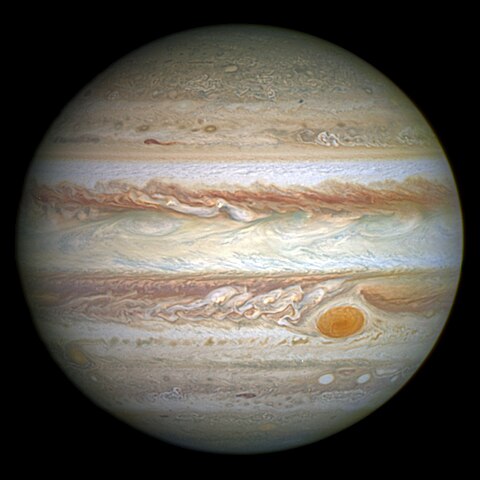
Planet Information
Location: Beijing
Updated: 2026-08-01 13:57:01+08:00
| Property | Value |
|---|---|
| Right Ascension | 08h36m39s |
| Declination | +19°04'14" |
| Constellation | Cancer |
| Azimuth | 234.47401426349333° |
| Altitude | 59.40646632386835° |
| Elongation | 2.0652956143267818° |
| Earth Distance | 6.30095862417379 AU |
| Sun Distance | 5.286812528982636 AU |
| Earth Distance (km) | 942609993.5452003 km |
| Magnitude | -1.7834173332235883 |
| Angular Diameter | 30.596307035371115" |
| Phase Angle | 0.39643337924673405° |
| Illumination | 99.99880316731749% |
| Semi-major Axis | 5.202887 AU |
| Eccentricity | 0.04838624 |
| Inclination | 1.30439695° |
| Ascending Node | 100.47390909° |
| Argument of Perihelion | 273.86740533° |
| Mean Anomaly | 121.12867226975573° |
| Epoch | J2000.0 |
| Orbital Period | 4332.59 days |
| Mass | 1.8982e+27 kg |
| Radius | 69911 km |
| Density | 1.326 g/cm³ |
| Surface Gravity | 24.79 m/s² |
| Escape Velocity | 59.5 km/s |
| Perihelion | 4.95113886092512 AU |
| Aphelion | 5.454635139074879 AU |
| Orbital Velocity | 13.064365996964714 km/s |
| Rotation Period | 9.925 hours |
| Axial Tilt | 3.13° |
| Rise Time | N/A |
| Transit Time | N/A |
| Set Time | N/A |
| Visible Duration | 0.0 hours |
| Best Observation | N/A |
| Quality Rating | Unknown |
Annual Trajectory Chart
Error Loading Chart
Daily Altitude Chart
Loading altitude chart...