
Mars
Detailed InformationAbout Mars
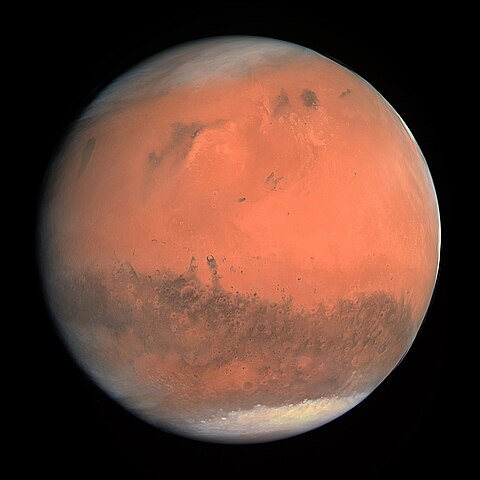
Mars is a world of ancient mysteries and future possibilities. Known as the Red Planet due to iron oxide on its surface, Mars has the largest volcano in the solar system (Olympus Mons) and a canyon system (Valles Marineris) that stretches across the entire planet. Evidence suggests Mars once had flowing water and a thicker atmosphere, making it a prime target in the search for past or present life. Today, Mars has polar ice caps and experiences seasons similar to Earth.
Quick Facts
- Known as the Red Planet
- Home to the largest volcano in the solar system
- Has evidence of ancient water flows
- Two small moons: Phobos and Deimos
Planet Information
Location: Beijing
Updated: 2026-07-30 09:07:55+08:00
| Property | Value |
|---|---|
| Right Ascension | 05h22m26s |
| Declination | +23°13'19" |
| Constellation | Taurus |
| Azimuth | 180.2271331984835° |
| Altitude | 73.34793587464316° |
| Elongation | 45.17690050498056° |
| Earth Distance | 2.00541973946892 AU |
| Sun Distance | 1.4771811134525363 AU |
| Earth Distance (km) | 300006522.88429916 km |
| Magnitude | 1.30132781344909 |
| Angular Diameter | 4.660800110268815" |
| Phase Angle | 29.17336432116146° |
| Illumination | 93.6574389639162% |
| Semi-major Axis | 1.52371034 AU |
| Eccentricity | 0.0933941 |
| Inclination | 1.84969142° |
| Ascending Node | 49.55953891° |
| Argument of Perihelion | 286.50210402° |
| Mean Anomaly | 41.708176730459854° |
| Epoch | J2000.0 |
| Orbital Period | 686.98 days |
| Mass | 6.4171e+23 kg |
| Radius | 3389.5 km |
| Density | 3.9335 g/cm³ |
| Surface Gravity | 3.71 m/s² |
| Escape Velocity | 5.03 km/s |
| Perihelion | 1.381404784135006 AU |
| Aphelion | 1.6660158958649942 AU |
| Orbital Velocity | 24.12958535269369 km/s |
| Rotation Period | 24.622 hours |
| Axial Tilt | 25.19° |
| Rise Time | N/A |
| Transit Time | N/A |
| Set Time | N/A |
| Visible Duration | 0.0 hours |
| Best Observation | N/A |
| Quality Rating | Unknown |
Annual Trajectory Chart
Error Loading Chart
Daily Altitude Chart
Loading altitude chart...