
Mercury
Detailed InformationAbout Mercury
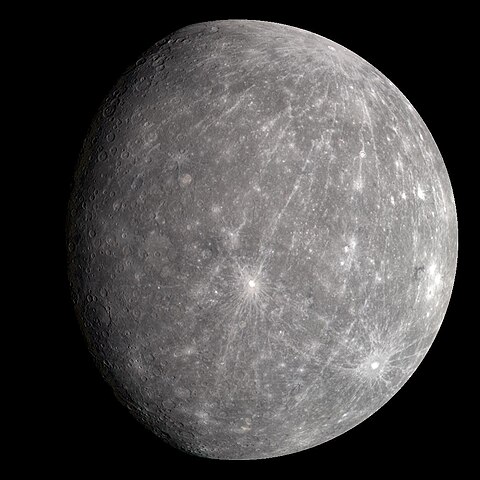
Mercury is a world of extremes. It's the smallest planet in our solar system and the closest to the Sun, experiencing temperature swings from 800°F (430°C) during the day to -290°F (-180°C) at night. Despite being the nearest planet to our star, Mercury is not the hottest planet – that title belongs to Venus. Mercury has the most eccentric orbit of all planets, and it completes three rotations for every two orbits around the Sun.
Quick Facts
- Closest planet to the Sun
- Smallest planet in our solar system
- No atmosphere to retain heat
- One day lasts 176 Earth days
Planet Information
Location: Beijing
Updated: 2026-07-30 14:04:53+08:00
| Property | Value |
|---|---|
| Right Ascension | 07h16m07s |
| Declination | +19°39'25" |
| Constellation | Gemini |
| Azimuth | 256.6186940695867° |
| Altitude | 45.764418547578245° |
| Elongation | 19.020880509625595° |
| Earth Distance | 0.8076804850805216 AU |
| Sun Distance | 0.36410262979789965 AU |
| Earth Distance (km) | 120827280.77398914 km |
| Magnitude | 0.6231756178362513 |
| Angular Diameter | 8.329653985558238" |
| Phase Angle | 114.68509524008546° |
| Illumination | 29.118463852462327% |
| Semi-major Axis | 0.38709927 AU |
| Eccentricity | 0.20563593 |
| Inclination | 7.00497902° |
| Ascending Node | 48.33076593° |
| Argument of Perihelion | 77.45779628° |
| Mean Anomaly | 16.653551451629028° |
| Epoch | J2000.0 |
| Orbital Period | 87.9691 days |
| Mass | 3.3011e+23 kg |
| Radius | 2439.7 km |
| Density | 5.427 g/cm³ |
| Surface Gravity | 3.7 m/s² |
| Escape Velocity | 4.25 km/s |
| Perihelion | 0.3074977516112289 AU |
| Aphelion | 0.46670078838877105 AU |
| Orbital Velocity | 47.87223915523033 km/s |
| Rotation Period | 1407.6 hours |
| Axial Tilt | 0.034° |
| Rise Time | N/A |
| Transit Time | N/A |
| Set Time | N/A |
| Visible Duration | 0.0 hours |
| Best Observation | N/A |
| Quality Rating | Unknown |
Annual Trajectory Chart
Error Loading Chart
Daily Altitude Chart
Loading altitude chart...